top of page
GMMTV vs Showbiz All-Star - Star Magic.jpg
Search

ni Madel Moratillo @News | February 26, 2025
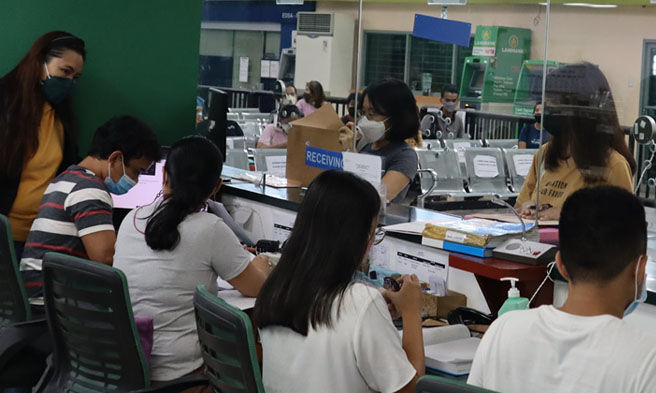


Workers / DMW

Photo File


Inaprubahan na ng Regional Tripartite Wages and Productivity Board ang dagdag na 20 hanggang 30 pesos sa arawang sahod ng minimum wage earners sa Davao Region. 

Sa anunsyo ng Department of Labor and Employment (DOLE), ang wage hike ay ipapatupad sa 2 tranche. Ang una ay sa Marso 13 at sa Setyembre 1 naman ang ikalawa. 


Sa oras na maging epektibo, ang daily minimum wage na para sa mga nasa sektor ng agrikultura ay magiging P525 mula sa dating P505 habang mula naman sa P510 ay magiging P540 sa mga nasa non-agriculture sector. Dahil dito, ang buwanang sweldo ay nasa P13,693.75 at P14,085 na. 


Sabi ng DOLE, nasa 66,772 minimum wage earners sa rehiyon ang makikinabang dito. 

Kasabay nito, inaprubahan din ang P500 dagdag sa buwanang sahod ng mga kasambahay para sa nasa chartered cities at first-class municipalities sa Davao Region, at P1,500 naman sa nasa ibang munisipalidad. Dahil dito, magiging P6,500 na ang kanilang buwanang sahod.


Tinatayang nasa 64,111 domestic workers sa rehiyon ang makikinabang dito. 

Exempted naman sa wage hike ang mga negosyong wala pang 10 ang manggagawa at naapektuhan ng kalamidad. Pero dapat mag-aplay muna sila ng exemption sa DOLE hanggang sa Mayo 11.


by Info @Brand Zone | February 26, 2026


Pag-IBIG

Pag-IBIG Fund returns at least 70% of its annual net income to members as dividends. In 2024, the agency declared dividend rates of 6.60% for Regular Savings and 7.10% for Modified Pag-IBIG 2 (MP2) Savings, its highest since the pandemic.


Pag-IBIG Fund said its investment income rose nearly 50% to ₱9.43 billion in 2025, reinforcing the agency’s strong fiscal position and helping sustain affordable home financing and growing member savings, officials said Wednesday (Feb. 25).


The stronger investment earnings helped lift Pag-IBIG Fund’s overall financial standing. At year-end 2025, the agency’s total assets rose to ₱1.23 trillion, while its gross investment portfolio increased to ₱190.13 billion, up ₱55.27 billion or 41.0% from year-end 2024. A large portion of the portfolio was invested in government securities, with the remainder placed in time deposits, corporate bonds and preferred shares, officials said, adding that these instruments undergo rigorous review and are subject to established safeguards.


“Pag-IBIG Fund’s investment growth demonstrates our commitment to responsible stewardship of our members’ savings,” said Department of Human Settlements and Urban Development (DHSUD) Secretary Jose Ramon P. Aliling, who also chairs the Pag-IBIG Fund Board of Trustees. “Through sound governance and prudent financial management, we continue to strengthen Pag-IBIG Fund’s financial position and secure its long-term stability. This allows us to grow our members’ savings, deliver competitive returns, and sustain affordable home loans under the Expanded 4PH program. In doing so, we answer President Ferdinand R. Marcos Jr.’s call for government to deliver benefits and services to help uplift the lives of more Filipinos.”


Of Pag-IBIG Fund’s total assets as of year-end, housing-related assets accounted for ₱922.07 billion, while ₱96.41 billion were in short-term loans. Income-generating investments totaled ₱190.00 billion, with the remaining ₱25.98 billion in other assets such as property and equipment, cash, and intangible assets.


Meanwhile, Pag-IBIG Fund Chief Executive Officer Marilene C. Acosta emphasized that investment decisions are undertaken within a strong governance framework designed to protect members’ savings.


“It is our responsibility to manage and grow the Filipino workers’ fund with prudence and integrity,” Acosta said. “All our investments are lawful, prudent, and fully compliant with our internal protocols and Board-granted authorities, with regular reporting to the Board to ensure transparency and accountability. Our members can be assured that every peso is managed with the highest regard for safety, sustainability, and their best interest.”


Acosta said stronger investment income supports Pag-IBIG Fund’s mandate of delivering competitive returns to members while sustaining housing and short-term loan programs nationwide.


“Every peso entrusted to Pag-IBIG Fund must be managed with safety, sustainability, and long-term value in mind. When we invest well, members benefit through stronger dividends, and more Filipino families benefit through affordable home financing,” she added.


Under its Charter, Pag-IBIG Fund returns at least 70% of its annual net income to members as dividends. In 2024, the agency declared dividend rates of 6.60% for Regular Savings and 7.10% for Modified Pag-IBIG 2 (MP2) Savings, its highest since the pandemic. Pag-IBIG Fund is expected to announce its 2025 dividend rates on Friday, Feb. 27.


Pag-IBIG Fund said it remains focused on growing members’ savings while keeping home financing within reach of more Filipino families.


by Info @Brand Zone | February 23, 2026


Integrating technology across the livestock value chain is seen as key to increasing farmer incomes and supporting regional food security. Following the meeting, the delegation toured ITDI’s state-of-the-art laboratories and technical divisions, where they were briefed on available technologies ready for adoption and commercialization


Through the Department of Science and Technology Region XII (DOST SOCCSKSARGEN), Hon. Rudy S. Caoagdan, Representative of the Second District of Cotabato and member of the House Committee on Science and Technology, paid a courtesy visit to the Department of Science and Technology Central Office in Bicutan, Taguig to explore science-driven opportunities that can accelerate agricultural and industrial development in his district.


Congressman Caoagdan together with DOST SOCCSSKARGEN Regional Director Engr. Sammy P. Malawan met with DOST Secretary Renato U. Solidum Jr., Regional Operations Undersecretary Sancho A. Mabborang, Countryside Development Assistant Secretary Engr. Maria Teresa B. De Guzman and Annabelle V. Briones, Executive Director of the Industrial Technology Development Institute (ITDI), to discuss potential collaborations that would harness innovation for coconut processing and cattle production in Cotabato Province.


As one of the key agricultural provinces in SOCCSKSARGEN, Cotabato has strong potential to move beyond raw commodity production toward value-added processing. Discussions highlighted the need to enhance coconut processing technologies to improve extraction efficiency, product quality, and compliance with national and international standards. 


By leveraging ITDI’s expertise in food processing, packaging, testing, and national metrology, local farmers and micro, small, and medium enterprises (MSMEs) can be supported in developing higher-value coconut products such as virgin coconut oil, coco sugar, flour, and other derivative products that command stronger market demand. The collaboration aims to ensure that producers are not limited to selling copra or raw nuts, but are empowered to participate in processing, branding, and commercialization.

Beyond coconut, the meeting also highlighted the need to strengthen Cotabato’s cattle industry. Recognizing the province’s growing livestock sector, Congressman Caoagdan sought DOST’s support in modernizing cattle production and meat processing through science-based interventions. 


Discussions focused on research-driven feed formulation, food safety testing, meat preservation, and improved packaging to enhance productivity, ensure quality standards, and expand market access. Integrating technology across the livestock value chain is seen as key to increasing farmer incomes and supporting regional food security.

Following the meeting, the delegation toured ITDI’s state-of-the-art laboratories and technical divisions, where they were briefed on available technologies ready for adoption and commercialization. The visit showcased ITDI’s capabilities in industrial research and development, standards and testing services, materials science, chemical and analytical services, food innovation, and national metrology – core pillars in strengthening local industries and accelerating economic growth. 


The convergence reflects a shared commitment to building an integrated innovation ecosystem that bridges national research institutions with grassroots communities.

With coconut and cattle identified as strategic growth drivers, Cotabato Province is positioning itself for a transition toward science-enabled, value-added agriculture. Through strengthened partnerships between national R&D institutions and local leadership, the province moves closer to transforming its natural resources into sustainable economic opportunities – demonstrating that from research laboratories to rural livelihoods, innovation is shaping the future of Cotabato.


RECOMMENDED
bottom of page