top of page
Search

by Info @Brand Zone | February 6, 2024


West Zone concessionaire Maynilad Water Services, Inc. (Maynilad) has started initial operations of its newly constructed Sewage Treatment Plant (STP) in Marulas, Valenzuela, which is designed to treat the wastewater generated by some 300,000 customers within nine barangays in Valenzuela City, making it safe for release to the ecosystem.


Maynilad’s Valenzuela Water Reclamation Facility—the company’s 23rd wastewater treatment facility—currently treats around 12 million liters per day (MLD) of wastewater generated by communities around the immediately vicinity of Marulas Creek. Once Maynilad completes the installation of a 27.4-kilometer sewer network in the city by 2024, the plant will be able to collect and treat wastewater of up to 60 MLD, serving barangays Gen. T. De Leon, Karuhatan, Malinta, Marulas, Maysan, Parada, Paso De Blas, and portions of Lingunan and West Canumay.


The Valenzuela Water Reclamation Facility is also among the STPs that Maynilad plans to eventually tap for the production of NEW WATER, or potable supply sourced from used water.


The company is also currently upgrading one wastewater facility in Caloocan, and constructing four new ones in Las Piñas, Bacoor, and Tunasan and Cupang in Muntinlupa. Once completed over the next five years, Maynilad’s total number of wastewater treatment plants will be 27 by year 2027.


by Info @Brand Zone | February 6, 2024


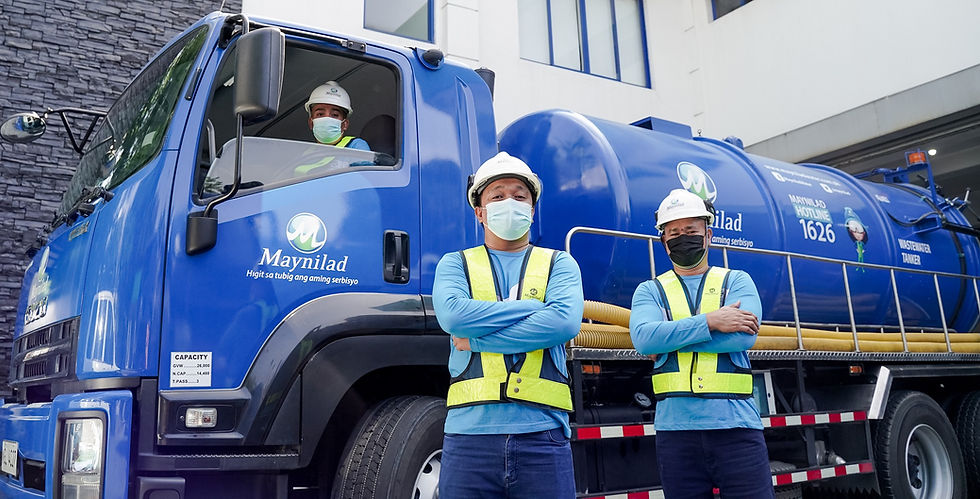
West Zone concessionaire Maynilad Water Services, Inc. (Maynilad) is offering septic tank cleaning services to its residential and semi-business customers this February in select parts of Caloocan, Las Piñas, Makati, Malabon, Manila, Muntinlupa, Navotas, Parañaque, Pasay, Quezon City, Valenzuela, and Cavite Province at no extra cost.


Maynilad’s sanitation program is one of the company’s efforts to lessen pollution loading into Metro Manila’s river systems. “We ask our customers to avail of this service, as it will help to protect community health and the environment,” said Maynilad Chief Operating Officer Randolph T. Estrellado.


Customers residing in Barangay 81, 82, 84 to 88, 90 to 95, 97 to 99, 101 to 103, 105, 106, 108 to110 in Caloocan; Brgy. Pamplona 1 and 3 in Las Piñas; Brgy. Maysilo in Malabon; Brgy. Putatan in Muntinlupa; Brgy. Bagumbayan North, Bangculasi, and Tanza in Navotas; Brgy. Don Bosco in Parañaque; Brgy. Capri, Bagong Silangan, and Holy Spirit in Quezon City; and Brgy. Mabolo, Mapulang Lupa, and Punturin in Valenzuela City may avail of Maynilad’s desludging service.


Moreover, some Maynilad customers in Cavite Province, particularly in Brgy. Aniban 2, 4, and 5 in Bacoor City; and Buhay na Tubig, Medicion 1-A to 1-D, Medicion 2-A, Medicion 2-C, and Medicion 2-D in Imus City may avail of the company’s septic tank cleaning services at no extra cost. Septic tank cleaning service normally costs around Php 4,700 per truck.


Maynilad customers interested in availing of the company’s septic tank cleaning service may call the Maynilad Hotline 1626 to determine the requirements and procedures. Additional information is also available in the company’s website, www.mayniladwater.com.ph, and social media accounts (X: @maynilad, Facebook: /MayniladWater).


Maynilad is the largest private water concessionaire of Metropolitan Waterworks and Sewerage System (MWSS) in the Philippines in terms of customer base. Its service area includes the cities of Manila (all but portions of San Andres and Sta. Ana), Quezon City (west of San Juan River, West Avenue, EDSA, Congressional, Mindanao Avenue, the northern part starting from the Districts of Holy Spirit and Batasan Hills), Makati (west of South Super Highway), Caloocan, Pasay, Parañaque, Las Piñas, Muntinlupa, Valenzuela, Navotas, and Malabon, all in Metro Manila; and the cities of Cavite, Bacoor, and Imus, and the towns of Kawit, Noveleta, and Rosario, all in the province of Cavite.


by Info @Brand Zone | February 2, 2024


West Zone concessionaire Maynilad Water Services, Inc. (Maynilad) has found another sustainable use for biosolids—the byproduct of the septage treatment process—with its “Bio-Bricks Project”, which involves converting biosolids into bricks that the company will utilize for constructing its facilities.


Bio-bricks are lightweight, cement-like materials that can be safely used as substitute for ordinary hollow blocks. During the project’s initial run, Maynilad plans to produce an initial 372,000 pieces of bio-bricks from an ECO Hub inside the company’s CAMANA Water Reclamation Facility in Caloocan. These will be used for building perimeter fences for Maynilad’s water and wastewater treatment plants, as well as non-load bearing structures for its various offices and facilities.


To produce the bio-bricks, Maynilad is partnering with GA Nexuz,Inc., a forerunner in using sustainable and green technologies in its products and services. Some of its projects include the construction of commercial buildings and houses using recycled plastics.


Maynilad produces around 23,000 cubic meters of biosolids annually. Biosolids are organic materials resulting from the treatment of septage collected from household septic tanks, and Maynilad typically has these biosolids hauled out for conversion to fertilizer or soil conditioner. With the “Bio-Bricks Project”, the company has established another means for biosolids to be used in a beneficial way, thus supporting its move towards a circular economy where all resources are reused and maximized.


“Besides contributing to the reduction of our carbon footprint, this project also improves operational efficiency, as it will help manage costs for the hauling and disposal of biosolids. Ultimately, this proves that the sustainability measures we apply to our operations can translate to actual business gains,” said Atty. Roel S. Espiritu, head of Maynilad’s Quality, Sustainability and Resiliency division.


Maynilad has been actively implementing environmental and sustainability initiatives in line with its goal of achieving carbon neutrality by 2037. Among these are its construction of solar farms to run facilities at La Mesa Compound, gradual shift from gas-powered vehicles to electric vehicles, construction of NEW WATER facilities that convert wastewater to potable water, and regular reforestation activities in vital watersheds, among others.


RECOMMENDED
bottom of page